
A Discovery That Rewrites History
For decades, archaeologists studying the Langobards—a fierce warrior people who dominated parts of Europe nearly 1,400 years ago—found skeletal evidence of violence exclusively in male remains. This pattern seemed to confirm assumptions that warfare and interpersonal violence were solely male experiences in Langobard society. That narrative has now been shattered by a single skeleton.
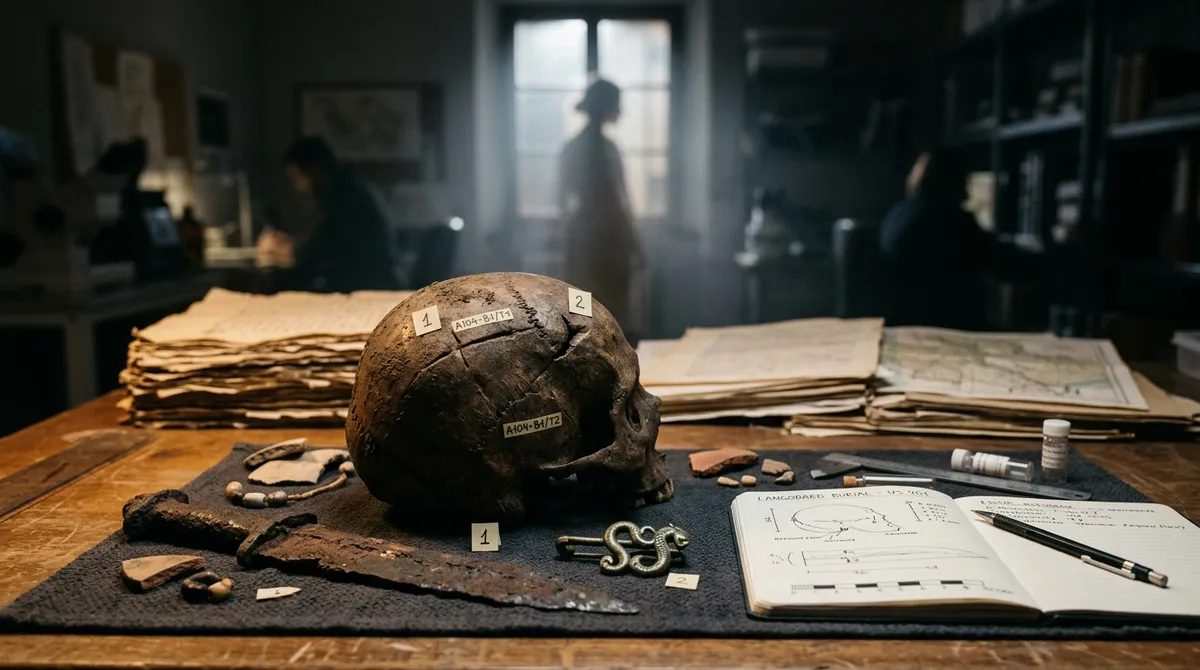
Researchers have discovered the first skeletal evidence of interpersonal violence in a Langobard woman, according to recent reports. The skeleton, known as T46, bears the unmistakable marks of two severe head wounds: a blade slash and a crushing blow. What makes this discovery even more remarkable is that she survived both injuries, living for years afterward with these traumatic wounds.
The Contradiction Between Laws and Bones
The discovery reveals a striking contradiction that has puzzled researchers for years. While archaeological evidence suggested violence was a male-only experience among the Langobards, historical legal documents from the same period tell a different story. According to reports, Langobard laws explicitly mention women both engaging in and experiencing violence.
This gap between what legal records documented and what skeletal evidence revealed has created what researchers now recognize as false historical narratives. The absence of physical evidence had led to assumptions about gender roles that may have been fundamentally incorrect.
Why Women's Violence Disappears from the Record
The scarcity of skeletal evidence for female violence isn't necessarily proof that it rarely occurred. According to reports, women's experiences with violence often leave fewer archaeological traces than men's for several reasons. Household abuse typically affects soft tissues rather than bones, making it invisible in skeletal remains. Additionally, women were less likely to participate in armed raids where fatal injuries to bones were more common.
These factors help explain why T46's case is so extraordinary—the injuries she sustained were severe enough to mark her bones permanently, providing the physical evidence that typically doesn't survive in the archaeological record.
Advanced Science Reveals Hidden Stories
Determining T46's sex required advanced scientific techniques, as the bones were too damaged for traditional identification methods. According to reports, researchers used protein analysis to confirm that the skeleton belonged to a woman. This technological approach demonstrates how modern scientific methods can unlock secrets that conventional archaeological techniques might miss.
The protein analysis was crucial because the severe damage to T46's skull made standard sex determination through bone morphology impossible. Without this advanced technique, her story might have remained untold.
A Story of Survival and Community Care
Perhaps the most compelling aspect of T46's story is not just that she experienced violence, but that she survived it. According to reports, she lived for years after sustaining her wounds, suggesting that her community provided care and support despite the severity of her trauma.
This survival indicates that Langobard society may have had mechanisms for caring for injured community members, regardless of gender. The healing patterns on her bones tell a story of resilience and perhaps community solidarity that extends our understanding of how these ancient people treated their wounded.
Implications for Future Research
T46's case opens new avenues for understanding ancient societies and gender roles. According to reports, future research directions include isotopic studies and ancient DNA analysis, which could potentially uncover more hidden cases of female violence in the archaeological record.
These advanced techniques might reveal that women's experiences with conflict and violence in ancient societies were more common than previously believed. The discovery underscores the importance of using multiple lines of evidence—legal documents, skeletal remains, and advanced scientific analysis—to build accurate pictures of the past.
Challenging Archaeological Assumptions
This discovery serves as a crucial reminder that gaps in archaeological evidence can create misleading historical narratives. The absence of evidence is not necessarily evidence of absence, particularly when it comes to understanding the experiences of marginalized groups in ancient societies.
T46's story demonstrates how a single skeleton can fundamentally challenge decades of archaeological interpretation and force researchers to reconsider long-held assumptions about gender, violence, and social roles in ancient cultures. Her survival and the care she received afterward paint a more complex picture of Langobard society than previously imagined.