The Quiet Quantum Revolution Nobody's Talking About
Quantum computers dominate the headlines, promising to crack encryption and simulate molecules in ways classical machines never could. But there's a quieter branch of quantum technology that's already doing useful work — right now, in hospitals, laboratories, and military navigation systems. Quantum sensors, which use atoms, electron spins, superconducting circuits, and light as extraordinarily stable measuring tools, are arguably the first truly practical application of the quantum age.
Unlike quantum computers, which remain fragile, error-prone, and largely experimental, quantum sensors are already being deployed in real-world settings. The core idea is elegant: quantum systems are exquisitely sensitive to their environment. That sensitivity, usually seen as a bug in computing, becomes a feature when your goal is measurement.
Measuring What Was Once Invisible
The fundamental promise of quantum sensing is precision at scales that classical instruments simply can't reach. These devices can detect fields, forces, and motions so small that conventional technology misses them entirely.
Take brain imaging. The human brain generates magnetic fields that are billions of times weaker than the field produced by a household magnet. Classical sensors struggle to pick up such faint signals. Quantum sensors, however, can detect these vanishingly small magnetic fields, opening new possibilities for non-invasive brain scanning. This could transform how doctors study neurological conditions, offering a window into brain activity with a clarity that earlier tools couldn't provide.
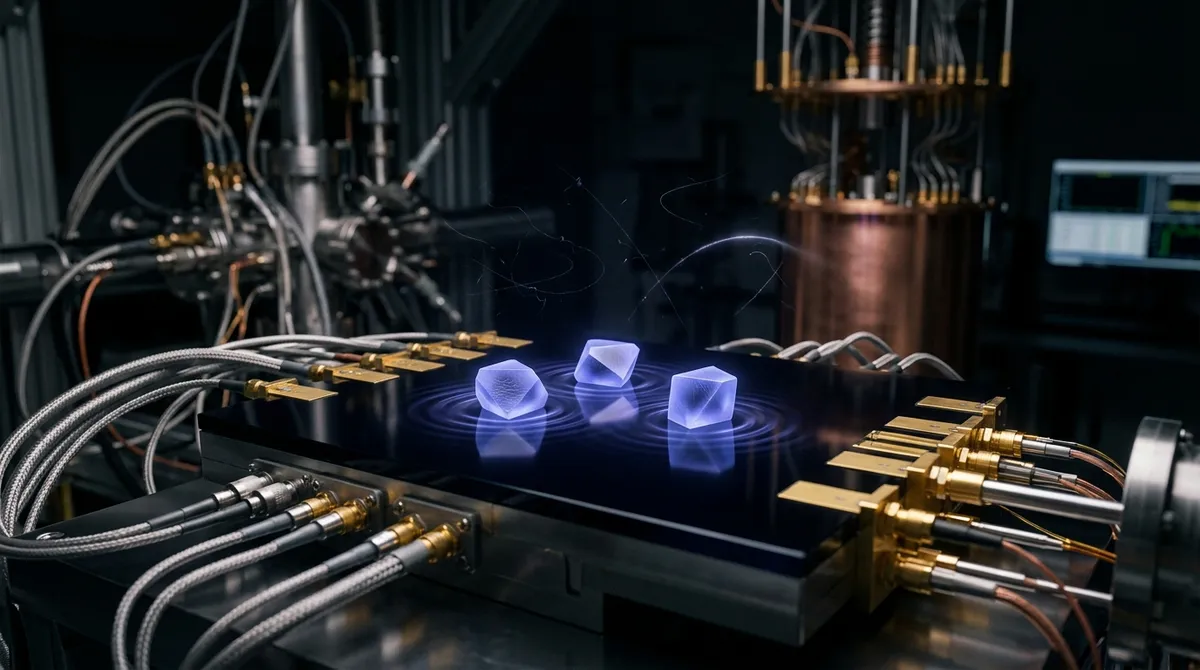
In semiconductor manufacturing, a different kind of quantum sensor is proving its worth. Defects in diamonds — carefully engineered flaws at the atomic scale — can be used to map magnetic fields across tiny areas of computer chips. As processors shrink and become more complex, the ability to detect minute electrical and magnetic irregularities in silicon is increasingly valuable for debugging and quality control.
A Backup for GPS — And More
One of the most strategically important applications of quantum sensing is navigation. GPS is the invisible backbone of modern life, guiding everything from smartphone maps to military operations. But GPS signals can be jammed or spoofed, a vulnerability that has become more pressing as electronic warfare capabilities grow.
Quantum navigation systems offer a potential solution. By using quantum sensors to detect motion, rotation, and gravitational variation with extraordinary accuracy, these systems can maintain precise positioning without relying on satellite signals at all. It's no surprise that militaries and airlines are paying close attention to the technology's development.
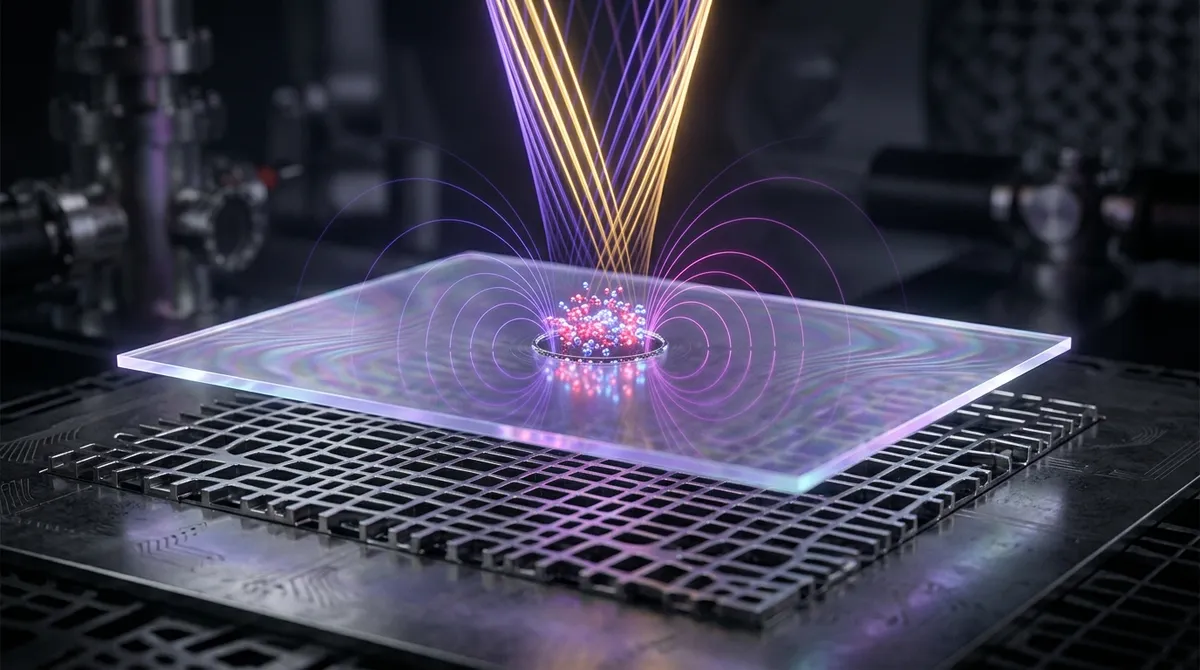
The underlying physics involves measuring how atoms behave under acceleration and rotation — changes that classical gyroscopes and accelerometers detect far less precisely. Quantum versions of these instruments could one day provide GPS-independent navigation that's resilient to interference.
Reading What's Buried Underground
Gravity mapping is another frontier where quantum sensors are beginning to make an impact. The strength of gravity at Earth's surface varies slightly depending on what lies beneath — water-filled cavities, mineral deposits, and underground voids all leave subtle gravitational signatures.
Quantum gravity sensors can detect these tiny variations with a sensitivity that opens up new possibilities for finding hidden resources. Whether the goal is locating groundwater in drought-prone regions, identifying mineral deposits for mining, or mapping underground infrastructure without digging, quantum gravimeters offer a non-invasive tool that could be transformative for both industry and environmental monitoring.
Why Quantum Sensors Succeed Where Computers Still Struggle
The reason quantum sensors are advancing faster than quantum computers comes down to their relationship with the environment. Quantum computers need to isolate their qubits almost perfectly from any external disturbance to prevent errors. That's an enormous engineering challenge.
Quantum sensors flip this requirement. They are designed to interact with their environment — and to do so with maximum sensitivity. The very thing that makes qubits hard to protect is what makes sensing quantum systems so powerful. A quantum sensor doesn't need to run complex calculations; it just needs to respond precisely and repeatably to whatever signal it's measuring.
This makes quantum sensors far more compatible with real-world deployment. They don't require the same extreme isolation or error-correction overhead that quantum computers demand.
The Quantum Revolution, Arriving Quietly
The broader narrative around quantum technology has long focused on computing — on the dramatic promise of machines that could outpace anything we have today. But as GPS jamming becomes a genuine security concern, as medical imaging demands grow, as semiconductor chips push ever closer to physical limits, and as the need to locate underground resources intensifies, quantum sensors are stepping up to meet real problems.
The quantum revolution, it turns out, may not announce itself with a breakthrough calculation. It may arrive in the form of a brain scanner that sees what others miss, a navigation system that works when satellites go dark, or a sensor that finds water beneath a dry and cracking landscape. The atoms, electrons, and light at the heart of these instruments are already serving as ultra-steady rulers for an invisible world — and only getting better at the job.