A Rare Conservation Success Story
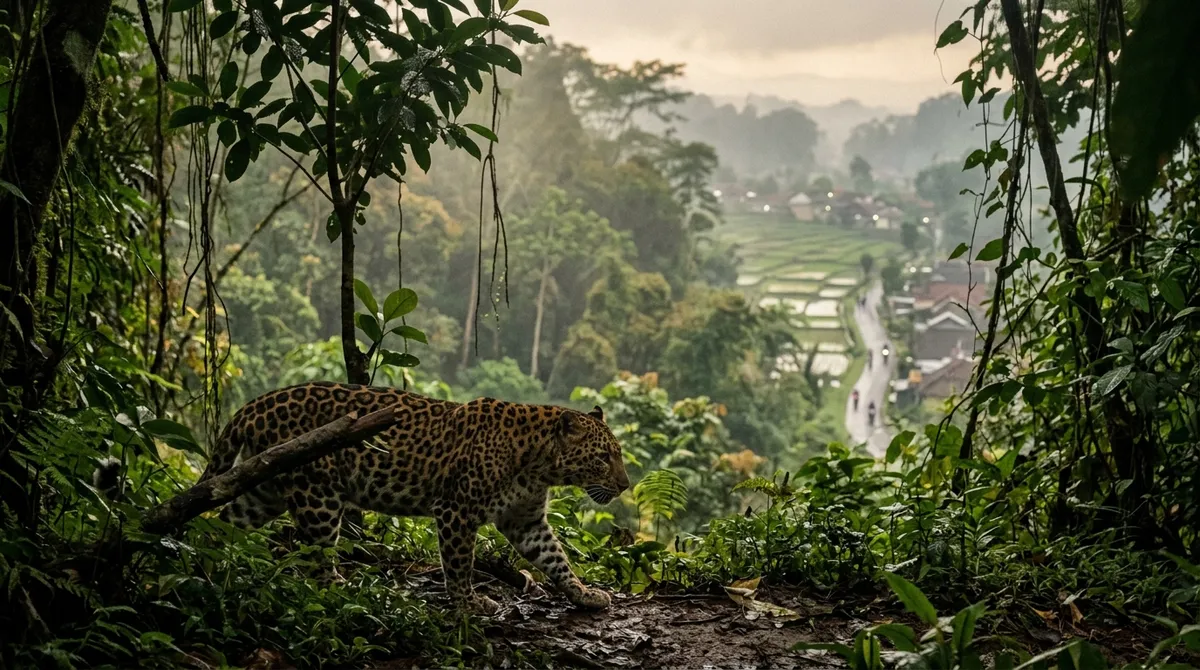
In one of the world's most densely populated islands, where over 150 million people call Java home, an extraordinary survival story is unfolding. The Javan leopard, one of Earth's rarest big cats with fewer than 350 individuals remaining, has defied the odds by adapting to life in a landscape dominated by human activity.
New research from the University of Twente reveals how these elusive predators have managed to persist where many other large carnivores have vanished. Using camera traps and sophisticated spatial modeling, scientists discovered that the leopards' survival strategy extends far beyond the boundaries of protected reserves.
Beyond Protected Boundaries
The study challenges conventional conservation wisdom by showing that Javan leopards don't just rely on pristine wilderness areas. Instead, they've adapted to thrive in regenerating secondary forests and utilize habitat corridors that connect fragmented landscapes across the island.
This adaptability has proven crucial on Java, where roads, railways, and expanding cities continue to fragment the remaining forest patches. The research demonstrates that these "second-rate" regenerating forests are doing heavy lifting in conservation efforts, serving as vital habitat for the species' survival.
Diverse Diet, Diverse Habitats
According to reports, the Javan leopards have developed a flexible approach to both hunting and habitat use. Their ability to exploit diverse prey sources has allowed them to maintain populations across various landscape types, from protected reserves to secondary growth forests.
This dietary flexibility, combined with their use of forest corridors, has enabled the species to navigate Java's complex mosaic of human development and natural areas. The findings suggest that conservation efforts must look beyond traditional protected area boundaries to ensure the species' long-term survival.
Mapping the Path Forward
The University of Twente research provides more than just insights into leopard behavior—it offers actionable guidance for conservation planning. The spatial modeling reveals exactly where strategic interventions could have the greatest impact on species survival.
The study identifies critical areas where reforestation efforts and habitat corridor development could significantly benefit the remaining leopard population. This data-driven approach helps conservationists and planners prioritize limited resources for maximum conservation impact.
A Fragile Success Story
While the Javan leopard's persistence represents a rare conservation success story, researchers emphasize its fragility. As large carnivores continue to vanish globally due to habitat loss and human pressure, the situation on Java serves as both an inspiration and a warning.
The research highlights the urgent need for landscape-level conservation planning that goes beyond traditional protected area approaches. With Java serving as a microcosm of global wildlife challenges in human-dominated landscapes, the lessons learned here could inform conservation strategies worldwide.
Conservation Beyond the Fence
The findings underscore a critical shift in conservation thinking: protected areas alone cannot save large predators in today's world. The Javan leopard's survival depends on a network of habitats that includes secondary forests, corridors, and strategically managed landscapes that allow for both human activity and wildlife persistence.
This research demonstrates that effective conservation in densely populated areas requires innovative approaches that work with, rather than against, human development patterns. The success of the Javan leopard suggests that with careful planning and strategic habitat management, it's possible for large predators and human communities to coexist even in some of the world's most crowded places.
As conservationists continue to grapple with habitat fragmentation and human encroachment worldwide, the Javan leopard's story offers both hope and a roadmap for protecting the planet's remaining large carnivores in an increasingly human-dominated world.