Most Stars Travel in Packs
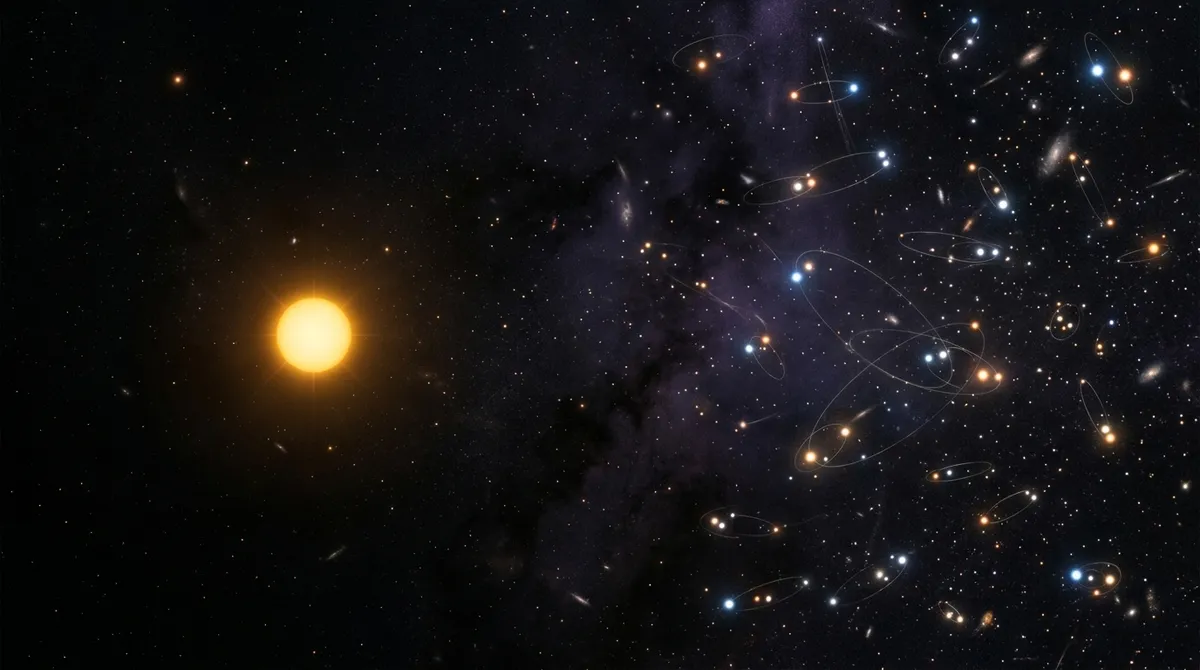
Our sun is something of a cosmic loner, lacking a stellar companion as it journeys through the galaxy. While this might seem normal from our Earth-bound perspective, a comprehensive new study reveals that our solitary star is actually the exception rather than the rule.
According to reports, a recent arXiv study has created what researchers describe as a near-complete census of multiple star systems within 10 parsecs of Earth. The investigation identified 424 stellar and sub-stellar objects, mapping out 92 bound multi-star systems in our immediate cosmic neighborhood.
Size Matters in Stellar Companionship
The census reveals a striking pattern: higher-mass stars are far more likely to have companions, while low-mass red and brown dwarfs typically remain solitary. This finding suggests that stellar mass plays a crucial role in determining whether a star will "travel in packs" or journey alone through space.
The data shows that massive stars tend to form complex gravitational relationships with other stellar objects, sometimes creating systems where star pairs orbit each other over millions of years. Meanwhile, the smallest stars and brown dwarfs—objects too small to sustain nuclear fusion—appear to prefer cosmic solitude, much like our own sun.
Implications for the Hunt for Alien Earths
This stellar census isn't just an exercise in cosmic cartography—it has significant implications for the search for habitable worlds. Next-generation exoplanet missions, including NASA's planned Habitable Worlds Observatory and ESA's LIFE mission, will rely on clean target lists to maximize their observation efficiency.
According to reports, binary stars can significantly complicate planet searches. When astronomers target what appears to be a single star, hidden stellar companions can interfere with sensitive instruments designed to detect Earth-like planets. The gravitational dynamics of multi-star systems also affect planetary formation and stability, potentially making it less likely for Earth-like worlds to develop in these environments.
Why This Census Matters Now
The timing of this comprehensive survey is crucial. As space agencies prepare increasingly sophisticated missions to search for signs of life beyond our solar system, having accurate maps of our stellar neighborhood becomes essential. The study helps mission planners avoid wasting precious observation time on stars with hidden companions that could sabotage planet detection efforts.
The census also sharpens our understanding of stellar formation and evolution. By mapping which local stars are truly single, paired, or part of complex systems, astronomers can better understand the processes that led to our own solar system's formation.
Our Sun's Unusual Independence
The findings highlight just how unusual our sun's solitary nature really is. While we've long known that binary and multiple star systems are common throughout the galaxy, this detailed local census drives home the point that our sun's lack of a stellar companion makes it somewhat of an oddity in our cosmic neighborhood.
This independence may have been crucial for Earth's development. Single-star systems like ours provide more stable environments for planetary formation and evolution, potentially explaining why complex life was able to develop and thrive on our planet.
Looking Forward
As astronomers continue to refine their understanding of our local stellar environment, this census provides a foundation for future discoveries. The detailed mapping of nearby star systems will inform target selection for upcoming missions and help researchers better understand the relationship between stellar companionship and planetary habitability.
The study represents a significant step toward answering one of astronomy's most pressing questions: How common are Earth-like worlds, and where should we look for them? By understanding which stars in our neighborhood are truly alone—like our sun—scientists can focus their search efforts on the most promising targets for finding potentially habitable worlds.