A Neighborhood Survey Like No Other
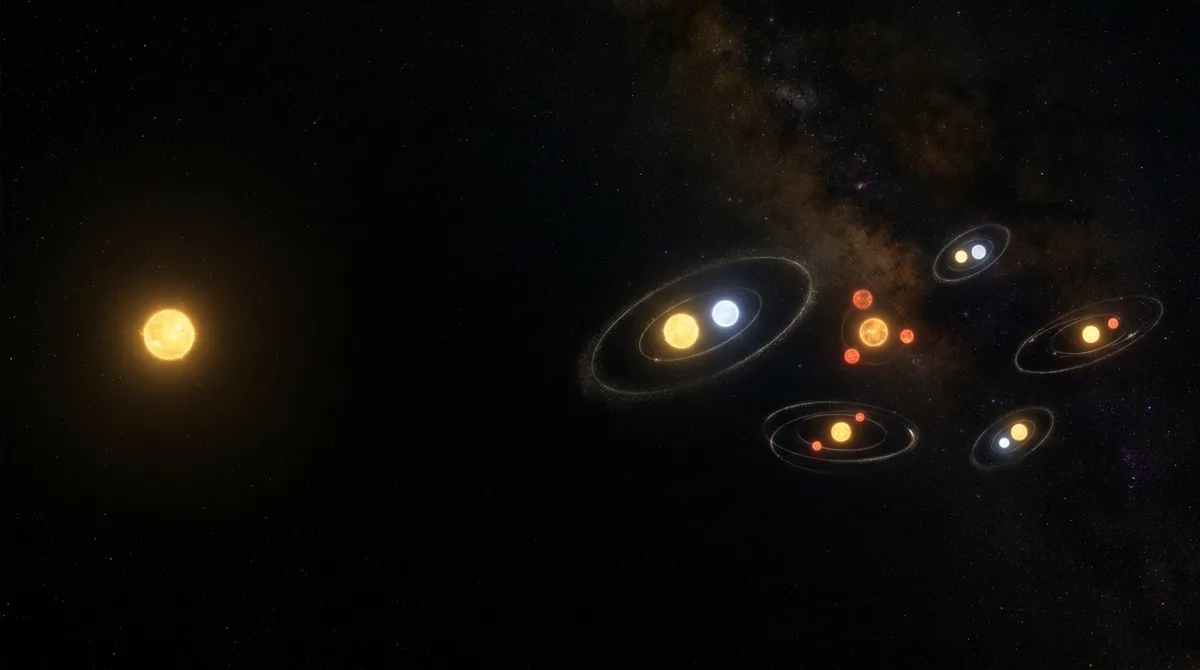
Our sun stands alone in space, lacking a stellar companion to orbit alongside it through the galaxy. While this might seem normal to us, a groundbreaking new study reveals that our solitary star is actually the exception rather than the rule in our cosmic neighborhood.
According to a recent arXiv study, researchers have completed a near-complete census of multiple star systems within 10 parsecs of Earth, cataloging 424 stellar and sub-stellar objects organized into 92 bound multi-star systems. The comprehensive survey paints a fascinating picture of stellar companionship in our local galactic region.
Mass Matters in Stellar Relationships
The study's most striking finding centers on a clear relationship between a star's mass and its likelihood of having companions. Higher-mass stars demonstrate a strong tendency to exist in multi-star systems, essentially "traveling in packs" through space. In contrast, low-mass red dwarfs and brown dwarfs typically remain solitary, much like our own sun.
This pattern suggests that stellar formation processes may favor different outcomes based on the mass of the resulting stars. While massive stars seem to form in environments that produce multiple gravitationally bound companions, smaller stars like our sun more often emerge as single objects.
Critical Implications for Exoplanet Hunting
The timing of this stellar census couldn't be more crucial for astronomy's next chapter. According to reports, next-generation exoplanet missions including NASA's Habitable Worlds Observatory and ESA's LIFE telescope will require precise target lists to maximize their effectiveness in searching for Earth-like worlds.
The presence of stellar companions can significantly complicate exoplanet detection and characterization. Binary stars and complex multi-star systems can sabotage planet searches by introducing additional gravitational influences and light contamination that obscures the subtle signals of orbiting worlds.
Mapping Our Cosmic Backyard
This comprehensive survey helps astronomers distinguish which nearby stars are truly single, which exist as binary pairs, and which participate in more complex multi-star arrangements. Such detailed knowledge proves essential for mission planners who must carefully select observation targets to avoid wasting precious telescope time on stars with hidden companions.
The census reveals some remarkable orbital relationships, including star pairs that orbit each other over timescales spanning millions of years. These extremely wide binary systems demonstrate the diverse range of stellar partnerships that exist in our galactic neighborhood.
The Hunt for Alien Earths
By creating this definitive map of stellar companionship within 10 parsecs, astronomers are essentially sharpening their tools for the search for nearby Earth-like planets. Understanding which stars in our cosmic backyard truly stand alone helps focus future observations on the most promising targets for discovering potentially habitable worlds.
The study transforms our understanding of stellar demographics in the solar neighborhood, revealing that our sun's solitary nature makes it somewhat unusual among its stellar peers. This "our sun is the weird one" perspective adds an intriguing twist to how we view our place in the galaxy.
Looking Forward
As we prepare for an era of unprecedented exoplanet discovery capabilities, this stellar census provides the foundational knowledge needed to optimize our search strategies. By knowing which nearby stars have companions and which stand alone, astronomers can better prioritize their observations and increase their chances of finding the next Earth-like world in our cosmic neighborhood.
The comprehensive nature of this 10-parsec survey ensures that future exoplanet missions will have the most complete picture possible of our local stellar environment, potentially revolutionizing our ability to detect and study potentially habitable worlds around nearby stars.