
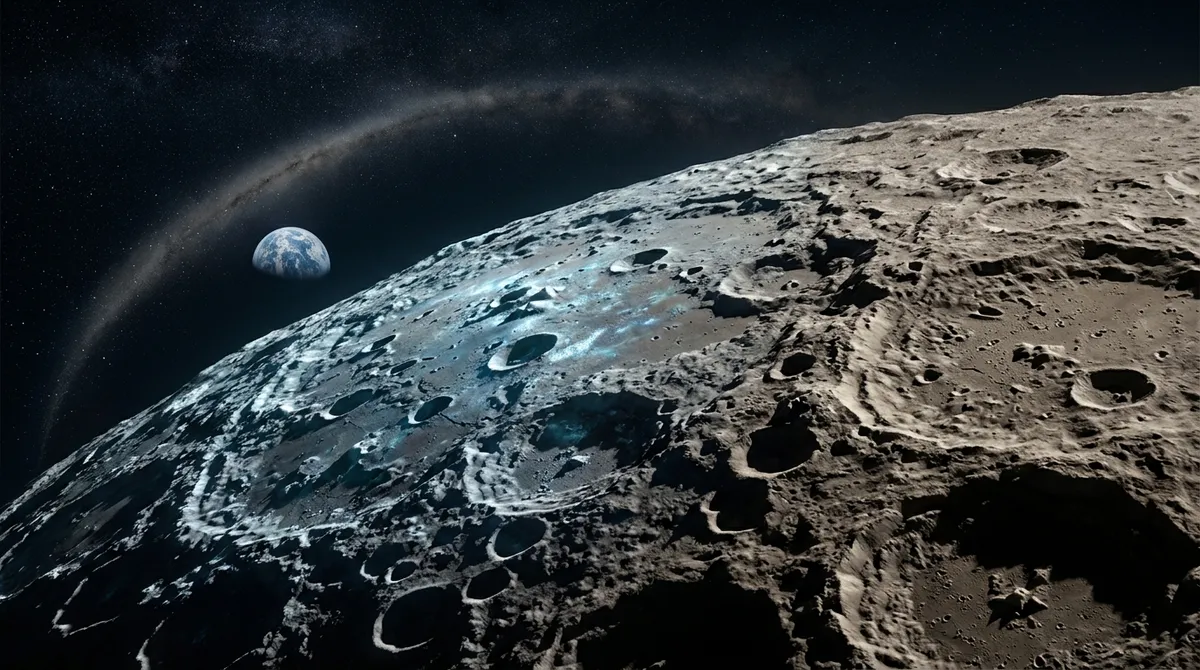
There's a captivating enigma unfolding on the moon's surface. It appears that a surprising water imbalance exists on our closest celestial neighbor, suggesting evidence of a past collision. The implications of this discovery are vast, as it could provide critical insight into the Moon's origins and its geological history.
The presence of water on the Moon, while not abundant, has always fascinated scientists. However, this moisture is not uniformly distributed. A team of researchers discovered that water concentration varies across the lunar surface, a phenomenon that has left them intrigued.
Unraveling the Lunar Water Mystery
A study, published in the renowned journal Science Advances, adds a new layer to the mystery. It suggests that the Moon's water imbalance may be a consequence of a significant impact event. This hypothetical collision could have exposed the lunar surface to solar winds, thereby causing the observed water asymmetry.
The research team, spearheaded by the University of California, used data from NASA's Lunar Reconnaissance Orbiter and India's Chandrayaan-1 mission. The study combined the data sets to create a comprehensive lunar water map. The map revealed an unexpected disparity in water concentration between the Moon's northern and southern hemispheres.
Implications of the Discovery
The discovery of the water imbalance could prove instrumental in our understanding of the Moon's history. If a collision event was indeed responsible, it indicates that the Moon has undergone significant geological changes over the course of its existence.
Moreover, the findings could also have practical implications for future lunar missions. Understanding the distribution of water on the lunar surface could aid in the planning and execution of manned missions, potentially opening up new avenues for lunar exploration.
What's Next for Lunar Research?
While the discovery is a significant step forward, it also presents new questions. To unravel the mystery behind the Moon's water imbalance, more research is needed. Future studies will need to focus on investigating the cause and nature of the water asymmetry.
Researchers are also interested in determining whether similar water imbalances exist on other celestial bodies. If so, it could provide valuable insights into the geological history of the solar system. Therefore, the research not only reshapes our understanding of the Moon but also potentially redefines our perception of the universe.
In conclusion, the discovery of a water imbalance on the Moon is a milestone in lunar research. It invites further exploration and study, promising to illuminate the history and evolution of our closest celestial neighbor. As we continue to unravel the Moon's mysteries, we are reminded of the awe-inspiring complexity and beauty of the universe that surrounds us.