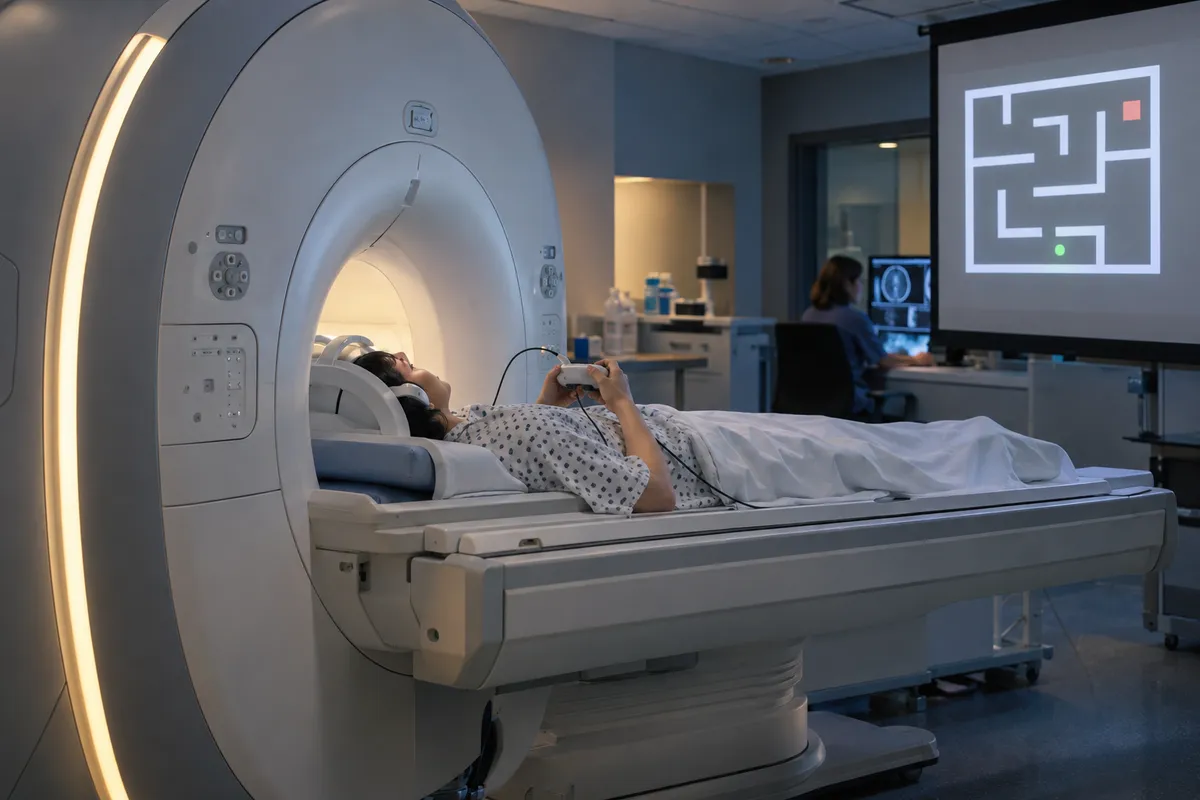
For decades, brain scans have worked like this: you lie very still inside a scanner and perform a carefully controlled task. By the end of this article, you'll know why a group of neuroscientists is swapping those tasks for video games, and what they hope to learn that older experiments could not show.
Per a report from Medicalxpress, neuroscientists at Western University are using video games inside fMRI scanners to study the brain under more realistic conditions. The work is tied to the Digital Brain Project, which aims to build a large open dataset of richer, more individual brain activity than traditional lab tasks can capture.
The problem with button-press science
According to Medicalxpress, those classic experiments, built on stillness and tightly controlled tasks, have revealed a remarkable amount about the brain. But they are also artificial. A person pressing a button when a shape appears on a screen is doing something very different from navigating a changing world.
That gap is the motivation here. Real life isn't a series of isolated prompts. You act, the world responds, and you adjust.
What a closed loop means
The Western University researchers are interested in what the report describes as "closed loop" conditions, where people predict, act, and adapt. In a closed loop, your actions change what happens next, and what happens next changes your actions.
Video games are a natural fit. In a game like Pac-Man (one of the examples the coverage highlights), you anticipate where a ghost will go, move, see the result, and revise your plan within moments. That cycle of prediction, action, and adaptation is something a simple button-press test struggles to reproduce.
This is our reading of why games matter: they give scientists a way to watch the brain doing what it does constantly outside the lab, rather than only in a stripped-down version of it.
From averages to individual brains
The Digital Brain Project's goal, per Medicalxpress, is a large open dataset capturing richer and more individual brain activity. That points to a broader shift in the field: mapping individual brains rather than averaging everyone together.
Averaging can blur what makes one person's brain organized differently from another's. Richer data from each person, gathered while they do something engaging and complex, could help bring those individual differences into focus. An open dataset also means other researchers could work with the same material.
The hardware and the funding
Two other ingredients are part of the story. The work involves upgraded 7-tesla MRI technology, and the coverage notes Meta-backed funding. We can't say from the reporting exactly what each will deliver, but higher-field scanners are generally associated with finer detail, which fits the interest in deep brain structures.
The project also sits where several fields meet: neuroscience, gaming, AI, and big data. Large, detailed datasets of people playing games are the kind of material that analysis tools can work with, though the specifics of how are not spelled out in the report.
What to watch for
The research is described in terms of goals and methods, not finished findings, so it's too early to say what the games will reveal. The promise is that gameplay could show what conventional scans miss.
That's a reasonable thing to be curious about. Some questions to keep in mind as results emerge:
- Do patterns seen during gameplay differ meaningfully from those seen in classic tasks?
- How much do individual brains differ when the task is open-ended?
- What can the open dataset tell researchers beyond the original study?
The takeaway
Next time you hear that someone is studying the brain, ask what the person in the scanner was actually doing. The Western University team is betting that the answer should look more like real life, and that a round of Pac-Man may tell us more than a button press ever could.