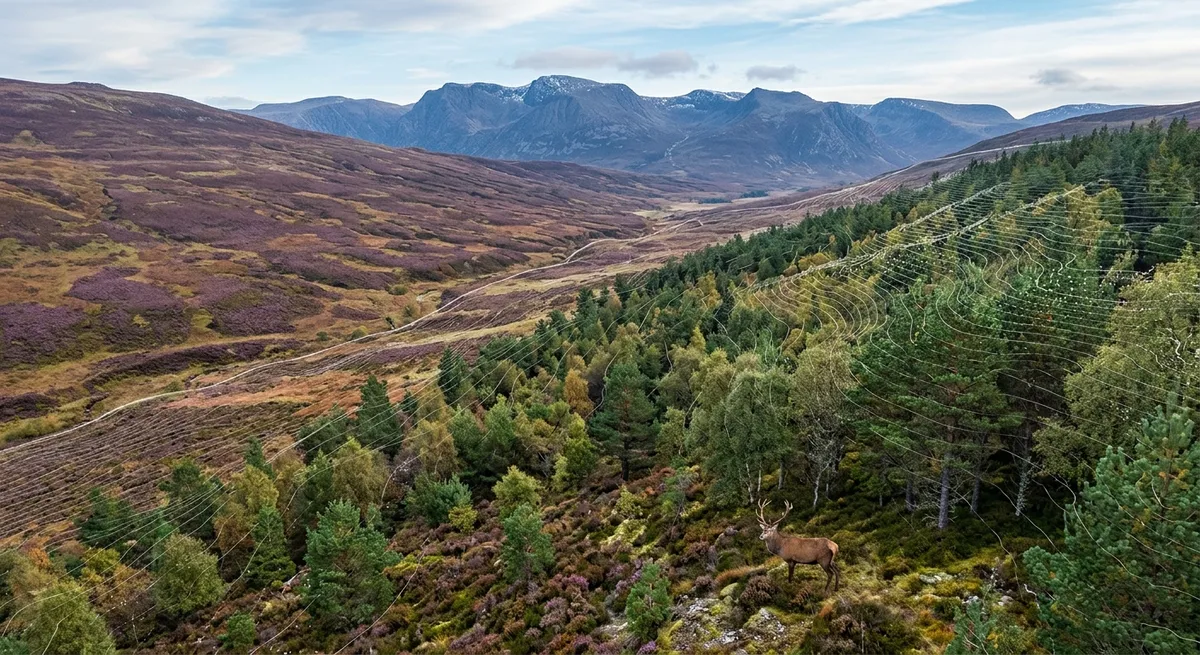
A recent study led by a team from Cambridge has uncovered remarkable news for Scotland's Cairngorms: over 6 million trees are now thriving across a vast 569 km² area, thanks to advanced AI-supported airborne LiDAR mapping. This innovative approach not only demonstrates the scale of natural woodland recovery but also highlights a crucial link between deer management practices and forest regeneration. In this article, we'll explore how these factors are working together to create a healthier ecosystem and contribute to larger environmental goals.
The Role of AI in Mapping Recovery
Using LiDAR technology, researchers can conduct aerial surveys that provide detailed maps of tree growth and land use. This technology sends out laser pulses that bounce back from the ground, creating high-resolution three-dimensional images of the forest landscape. With the ability to count and analyze tree density from the air, the Cambridge-led team successfully confirmed that the effort to manage deer populations has been instrumental in fostering young native tree growth.
Effective Deer Management
The study emphasizes how effective deer management has been a game-changer for woodland expansion. Over 5,235 hectares of land that was previously open is now supporting an abundant growth of young trees. Controlling deer populations ensures that these young saplings are not overgrazed, allowing them to grow into mature trees that contribute to biodiversity and carbon capture. Essentially, managing the deer population creates a more conducive environment for natural regeneration.
Why This Matters for Scotland
Scotland is ambitiously working to enhance its native woodlands for various critical reasons: carbon capture, biodiversity, and increased resilience to climate change. As the country moves towards ambitious targets for ecological recovery, evidence-based restoration practices become paramount. The findings from this study offer a scalable model for land managers who need a way to monitor and prove the success of their restoration efforts as nature recovery projects expand across the UK and potentially beyond.
A Hopeful Future for Rewilding
This recovery of the Cairngorms serves as a powerful case study in the larger movement of rewilding, the practice of allowing ecosystems to recover and thrive naturally. Unlike traditional tree planting, which often requires significant human intervention, the use of technology like LiDAR combined with savvy wildlife management is leading to a more organic and sustainable approach.
Implications for Biodiversity
The return of the woodland in this region not only boosts trees but also begins to restore ecosystems that can support various species, including capercaillie and red squirrels. This points toward a healthier and more balanced ecosystem with interconnected species that rely on each other for survival. It highlights the intrinsic value of forests as habitats that support a plethora of wildlife.
Conclusion
The success seen in Scotland's Cairngorms through AI technology and effective deer management offers a promising blueprint for forest recovery efforts around the globe. As restoration projects grow, the collaboration of science, technology, and ecosystem management will play a significant role in achieving a sustainable future. This isn’t just about growing trees; it’s about fostering a more resilient Earth for future generations.