Unlocking Dark Matter's Mysteries
Astrophysicists are making significant strides in understanding dark matter, one of the universe's greatest enigmas. A recent study suggests that gravitational lensing— where massive objects like galaxies bend light from distant sources— can serve as a tool to detect the elusive properties of dark matter. This innovative approach stems from simulations that model how ultralight, or 'fuzzy,' dark matter interacts with light, providing clues to one of physics' most pressing questions.
What is Gravitational Lensing?
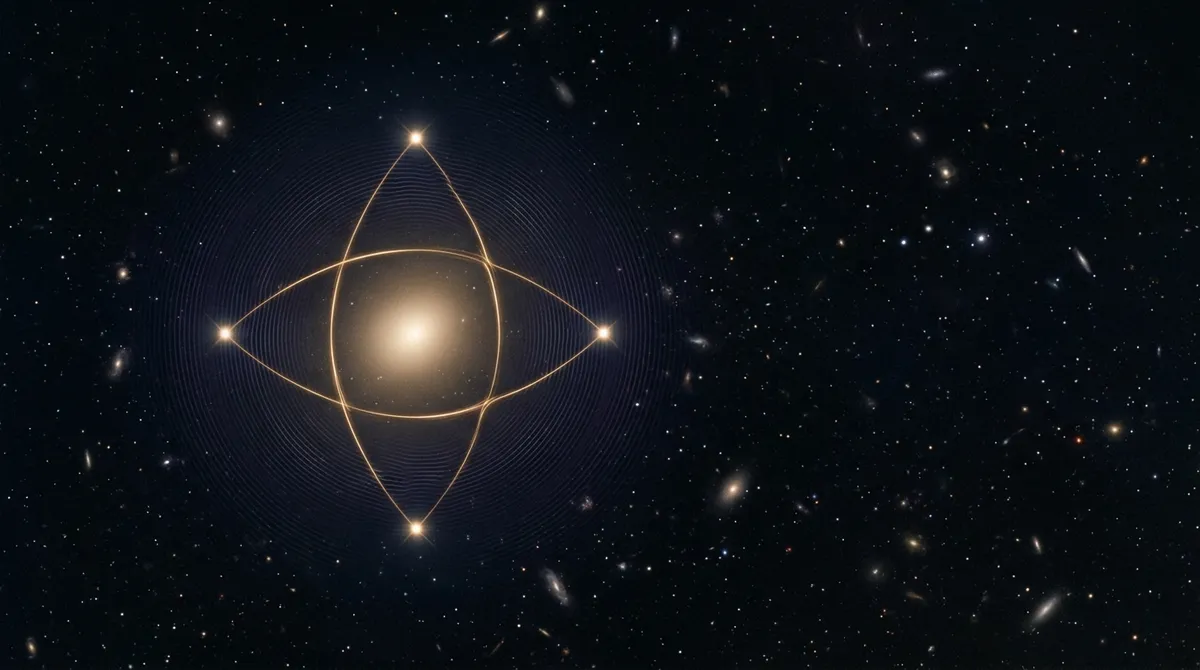
Gravitational lensing occurs when a massive object, such as a galaxy or cluster of galaxies, distorts the space around it, affecting the path of light from objects behind it. This bending can create multiple images of the same object, magnify distant quasars, or create arcs of light. Researchers harness this phenomenon as a cosmic magnifying glass, revealing details that would otherwise remain hidden.
The Role of Dark Matter in Lensing
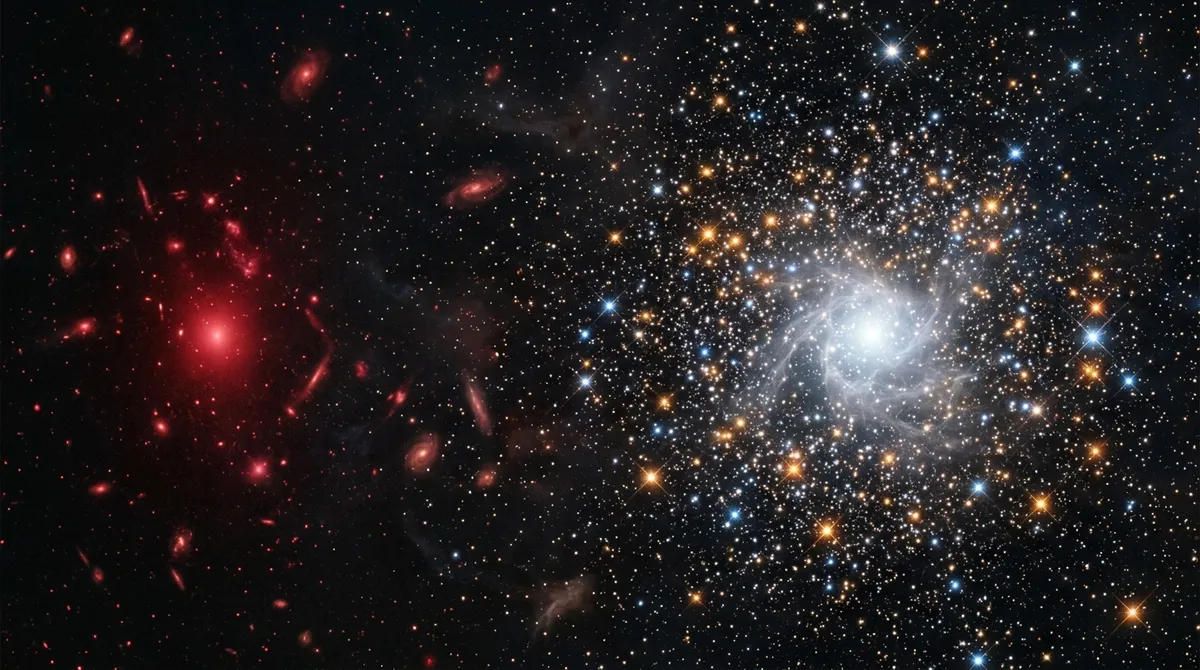
Dark matter is believed to make up about 27 percent of the universe, yet it cannot be observed directly. Instead, it influences the movements of galaxies and galaxies clusters through its gravitational effects. The study led by astrophysicists at The University of Hong Kong (HKU) and Beijing Normal University (BNU) proposes a new method using 3D wave simulations to explore how ultralight dark matter could affect the positions of gravitationally lensed quasar images.
By modeling the wave-like properties of this 'fuzzy' dark matter, researchers demonstrate that it could alter the light patterns observed through gravitational lensing. This is a departure from traditional models, which often treat dark matter as a solid mass. The findings suggest that gravitational lensing might act as a detector of dark matter's nature, revealing its presence through the subtle shifts in quasar images.
Why Wave Simulations Matter
The simulations incorporated a more physically realistic approach to account for the effects of ultralight particles. These particles are hypothesized to be lighter than typical dark matter candidates, leading to their wave-like behavior. This new perspective enabled scientists to predict how the gravitational field of dark matter would interact with light, aligning remarkably well with observed patterns from high-resolution telescopes.
By improving the predictions for how gravitational lensing appears, these simulations provide a powerful tool for unraveling dark matter's mysteries. The ability to match observed image positions better than existing models opens new pathways for exploring dark matter's characteristics.
Looking Ahead
As telescope technology advances, more accurate lensing observations are on the horizon. Future observations may provide the critical data needed to either confirm or challenge the ultralight particle models. This research ultimately aims to understand what dark matter is made of—information that could reshape our knowledge of the universe.
By employing gravitational lensing as a method of probing dark matter, scientists are transforming the cosmos into a unique laboratory for physics. Exploring how light interacts with these mysterious particles can lead to groundbreaking discoveries about the fundamental nature of the universe.
Your Takeaway
Gravitational lensing may hold the key to unlocking the enigmatic properties of dark matter. With new wave simulations, astrophysicists are closer than ever to revealing the true nature of these elusive particles, suggesting that our understanding of the universe is on the brink of a significant breakthrough.