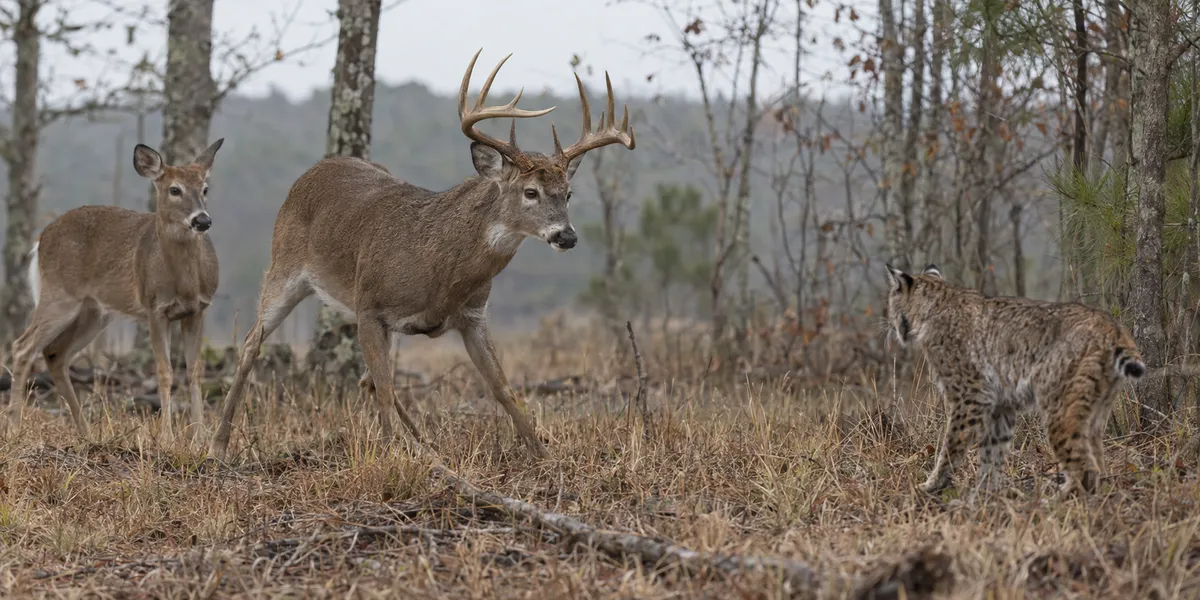
A trail camera in Georgia recorded a moment that looks scripted: a bobcat chases a doe, a buck charges in, and the buck tosses the predator through the air with its antlers. Fox News reported on the viral footage, and the clip is worth a closer look. By the end of this article, you'll know what the footage shows, how to read a deer's defensive behavior, and which parts of the "chivalry" story are fact and which are our interpretation.
What the footage shows
Per Fox News, the trail cam clip from Georgia captures three beats in quick succession:
- A bobcat chases a doe.
- A buck charges into the scene.
- The buck tosses the bobcat with its antlers, sending it through the air.
That's the full set of details we have, and it's a good reminder of what trail cameras do well. They sit unattended, trigger on motion, and catch events no person would plan to be present for. The result is raw wildlife behavior with no narrator and no staging.
Chivalry or something else?
The coverage framed the moment as chivalry in the animal kingdom. It's a fun read, and it's the reason the clip spread. But it's an interpretation, not something the footage can prove.
Here's the careful version. We can see a buck charge a bobcat that was chasing a doe. We can't know what the buck was "thinking." Plausible explanations include protecting the doe, reacting to a nearby threat, or simply defending its own space. The footage supports the action. The motive is our guess.
That distinction is the heart of reading any wildlife video well: describe what happened first, then speculate, and keep the two apart.
How deer defend themselves
Deer are prey animals, and most of their survival strategy is about spotting danger early and leaving. But when running isn't enough, they have real tools:
- Antlers. On a buck, they're the obvious weapon, and this clip shows them used to launch a predator.
- Charging. A direct rush can startle or drive off an animal that expected an easy chase.
- Stomping. Deer can use their hooves defensively as well.
Pairing those tools with surprise is what makes the Georgia clip so striking. The bobcat was focused on the doe. A charging buck came from a direction it wasn't watching.
Why this matters for predator-prey science
We tend to picture predator-prey encounters as one-sided: the hunter picks, chases, and wins or loses. Clips like this one show the messier reality. Prey can push back, and bystanders can change the outcome mid-chase.
A single video isn't data. It doesn't tell us how often a buck intervenes, how often a bobcat targets deer, or how this encounter ended beyond the toss itself. Those would need many observations, which is exactly what trail camera networks can eventually provide when footage is collected over time.
How to watch wildlife clips like a naturalist
When the next viral animal clip lands in your feed, try this quick routine:
- Write down the sequence. What literally happened, in order?
- Spot the trigger. What changed right before the key action?
- Label the guesses. Anything about feelings or intentions is a hypothesis.
- Ask what's missing. Camera angle, time of day and what came before the clip all shape the story.
Apply it to the Georgia footage and you get a clean result: a chase, a charge, a toss. The rest is the part that makes us smile.
The takeaway
Enjoy the drama, but watch it like a scientist: note what the camera caught, label what you're inferring, and let the antlers do the talking.