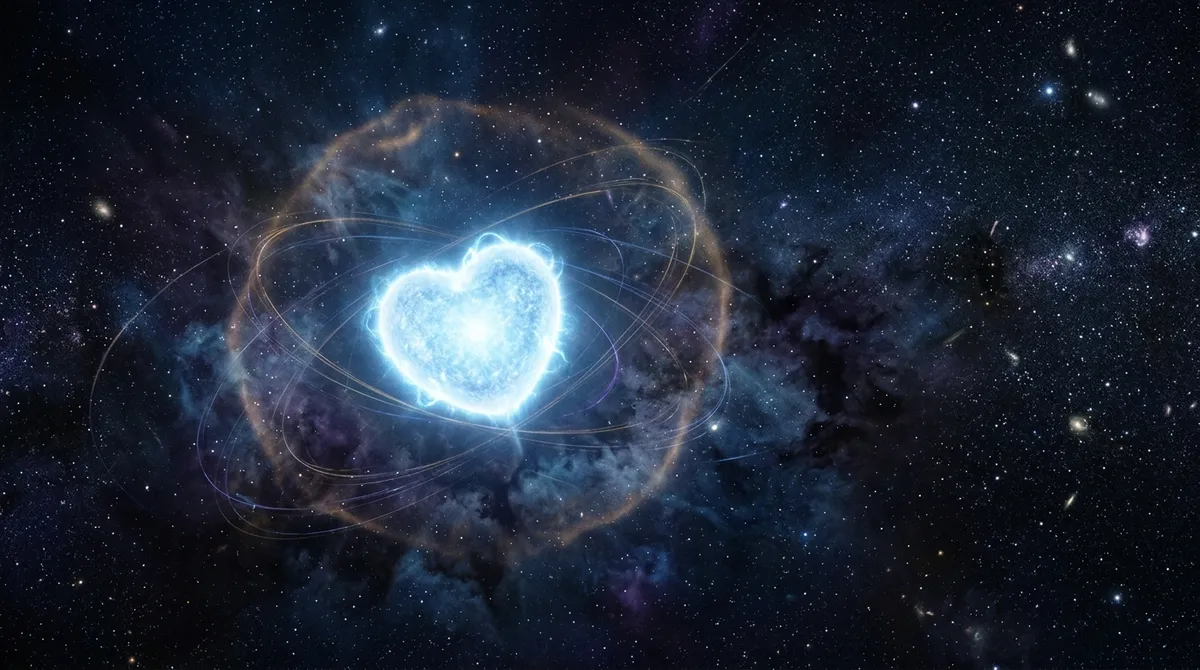
In a distant part of the cosmos, an unusual star named HD74423 has been discovered, verifying a long-held astronomical prediction. By its unique behaviour, it has been identified as a heartbeat star, destined to explode in a supernova. This astronomical marvel was captured by the Transiting Exoplanet Survey Satellite (TESS), making it the first time such a phenomenon was confirmed.
HD74423 is located approximately 1,500 light-years away in the constellation Serpens. It's distinguished by its pulsations, which are observed only in one hemisphere. Unlike other typical stars, where pulsations occur on a global scale, this star's pulsations are confined to one side due to its close proximity to a red dwarf. The tidal forces from the red dwarf distort the star, causing it to 'beat' in an unusual pattern.
Heartbeat Stars and Their Significance
Heartbeat stars are binary systems consisting of two stars orbiting close to each other, causing gravitational interaction that leads to elliptical orbits. These stars can offer significant insights into stellar evolution and the life cycle of stars. The discovery of HD74423, with its unique pulsation pattern, is a significant step in understanding the nature and behaviour of heartbeat stars.
TESS's Role in the Discovery
The Transiting Exoplanet Survey Satellite (TESS) played a crucial role in this discovery. Launched by NASA in 2018, TESS is designed to search for exoplanets using its four wide-field cameras to monitor over 200,000 stars. It was during this mission that TESS detected the peculiar light fluctuations of HD74423, leading to its identification as a heartbeat star.
The Future of Stellar Observation
The detection and study of HD74423 have opened up new avenues in the field of astronomy. It will help enhance our understanding of the life cycle of stars and the forces that dictate their evolution. Furthermore, it will provide valuable insights into the characteristics and behaviours of other heartbeat stars yet to be discovered.
In conclusion, the discovery of HD74423 is a testament to the power of technological advancements in space exploration and observation. As we continue to explore the depths of the universe, who knows what other celestial wonders await us? The cosmos is full of mysteries, and each discovery brings us one step closer to understanding the grand design of the universe.